
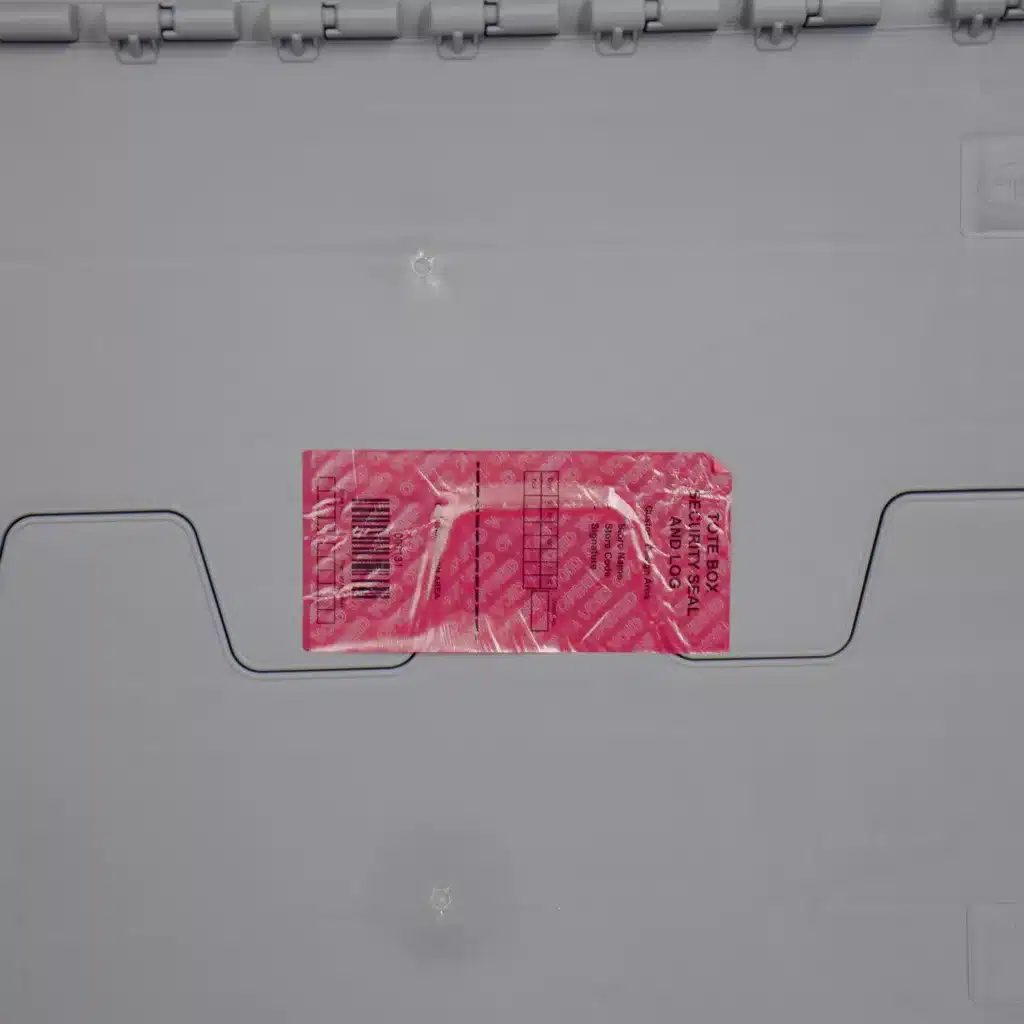
Controlled drugs move between a pharmacy, a hub, a ward or a patient’s home in ordinary totes and bags, handled by people who are not part of the pharmacy team. The register records who signed for the container. What it cannot record is whether anyone opened it between two signatures.
That is the specific weakness a tamper-evident seal addresses — and it is worth being precise about it, because in this sector overstated claims cause real problems.
The regulatory context
Handling of controlled drugs in Great Britain sits under the Misuse of Drugs Act 1971 and the Misuse of Drugs Regulations 2001, with storage requirements in the Misuse of Drugs (Safe Custody) Regulations 1973. Professional expectations for pharmacy practice are set by the General Pharmaceutical Council,; local processes are overseen through Controlled Drugs Accountable Officer arrangements.
None of that legislation mandates a particular tamper-evident label, and no seal makes an organisation compliant on its own. What a seal can do is give a documented, inspectable control that supports the audit trail your CD policy already requires. Confirm your own arrangements with your Accountable Officer before changing a procedure.
Where the risk actually sits
- Between handovers. A sealed tote passing through a courier network or a hospital porter route is out of the pharmacy’s sight for hours.
- Partial diversion. Removing part of a quantity is harder to notice at receipt than a missing package, especially if the paperwork is only checked at package level.
- Ambiguous incidents. Without a physical seal, a discrepancy at the receiving end cannot be located in the chain, which turns a single query into a full investigation.
- Home and community delivery. Deliveries to a patient’s address or to a residential setting involve the least supervised part of the journey.
What a tamper-evident seal contributes

- A visible interference check that the receiving person can inspect in seconds, rather than a signature that only records custody.
- A unique reference per movement. A serialised seal recorded against the CD register entry means a mismatched number is as significant as a broken seal.
- Deterrence. A numbered seal signals that opening will be noticed by someone whose job is to check it.
- Faster resolution. An intact, matching seal lets a query be closed at the point of receipt.
The limits matter just as much. A seal does not prevent access, does not identify who opened the container, and does not verify the contents. It provides evidence that the closure was disturbed. Any policy that treats an intact seal as proof that nothing was removed upstream of sealing is relying on the wrong control.
Specifying for pharmacy conditions
Choose non-residue on reusable totes
Pharmacy totes are washed and reused. A permanent, high-tack construction leaves adhesive that builds up over cycles, and the practical result is that staff stop sealing or spend time cleaning. A non-residue polyester construction gives a clear VOID message and releases cleanly from the tote wall. Detail here: pharmacy controlled-drugs tote box labels.
Match the surface
Textured polypropylene totes, smooth polyethylene crates, kraft bags and coated cartons behave differently. Textured surfaces reduce the effective contact area, so an adhesive that performs on a smooth crate can lift at the edge on a ribbed one. For blister and pack-level sealing see pill box labels.
Allow for temperature and condensation
Fridge lines and cold-chain totes collect surface moisture as soon as they come out of a chiller. Applying a seal to a damp wall is the most common reason a seal is found lifted at delivery. Dry the surface, or apply before chilling. Cold-chain context: insulated box security.
Pressure and dwell time
Seals need firm pressure over the whole label and a short period to reach full bond. A seal pressed on with a thumb-tip as the tote leaves is not the same seal as one applied properly with the lid supported.
Placement
Bridge the lid and the body across the opening, so opening the tote must break the seal. A label on the lid face proves nothing.
Building it into the process
- Seal at the point of dispatch, after the register entry, and record the seal number against that entry.
- Brief the receiving end on what to check: seal intact, number matches, no lifted edges or VOID message.
- Define the exception route — who is told, what is photographed, whether the container is quarantined — before rollout, not after the first discrepancy.
- Include seals in your CD audit so the control is evidenced rather than assumed.
- Review void reports. Repeated voids on one route usually indicate handling or condensation, not diversion. Investigate both.
Next step
Sector overview: pharmaceutical packaging security. Related reading: tamper-evident seals and chain of custody.
If your construction is already agreed, discuss your requirement. If you are working with a specific tote, bag or fridge line and need to know what will hold, send us the pack and the problem and we will test it against your surface and temperature.