
Last updated:
The short answer
A TamperTech paper tamper evident label seals a delivery order in about a second by hand, comes on one tidy roll, and shows a clear VOID or branded message the moment anyone lifts it. A printed paperboard case is slower to fit, bulkier to store, creates more loose waste at the counter and gives weaker evidence of whether an order has been opened.
Once an order leaves the kitchen it is out of sight. When a customer says items are missing or the food has been interfered with, the restaurant, the courier and the customer all need the same answer to one question: was this bag opened on the way? The seal on the bag is the only thing that can answer it.
This article compares the two common ways of closing a takeaway or delivery bag: a printed paperboard case (a folded card sleeve or tab fitted over the bag top, often held with a peel-off adhesive strip) and a TamperTech paper tamper evident delivery label made to whatever size the closure needs.
Less silicone liner waste
With labels, the only release liner is the continuous roll backing, which leaves the packing bench as one roll and one core. A board case held by a peel-off strip leaves a separate siliconised backing strip behind for every single order.
- One roll, not thousands of strips. Labels are supplied on rolls, so the waste from many orders is one spent liner roll that can be bagged and collected in one go.
- Nothing loose at the bench. Small, shiny backing strips get dropped, swept into corners and stuck to shoes and surfaces.
- A cleaner waste stream. Siliconised strips are not ordinary paper waste. Concentrating the liner on a roll makes it easier to segregate, and to send to a liner recycling scheme where one is available.
- Less material overall. A label is a thin paper face and adhesive. A board case adds a heavy board blank on top of its adhesive strip and liner, so there is more material to buy and more to throw away per order.
Quicker to apply
A finger-lift label from a roll takes about a second per order by hand: lift, place across the fold, press. A board case needs the blank picked from a box, folded or opened, slid over the bag top, then a backing strip peeled and the case pressed shut.
- One movement instead of several. Every extra handling step at the packing bench adds time at exactly the moment the kitchen is busiest.
- Designed to be easy to handle. Finger-lift tabs are designed to be picked cleanly from the roll; peeling a narrow backing strip off a board tab is fiddly.
- Automatic application. Ask us about formats for automatic application.
- Order data printed at dispatch. Where order numbers are printed at the moment of packing, direct thermal tamper evident labels let the seal and the order label be one item, removing a step altogether.
Across a busy evening service of several hundred orders, a few seconds saved per bag adds up to real staff time and faster handover to drivers.
Genuine security, not just closure
TamperTech labels are dry peel: once lifted, no tacky adhesive is left on the label or the pack, so it cannot be stuck back down. Lifting it releases a VOID layer straight away, and the message stays visible on the bag for the driver and the customer to see.

A printed board case closes the bag, but it was designed as packaging, not as security:
- It can often be eased off and refitted. A sleeve or tab that slides over a folded bag top can be slipped off and back on with care, and an adhesive strip on board can be lifted and pressed back down. Either way, nothing obvious tells the customer it happened.
- The evidence is damage, and damage is arguable. If a board case looks bent or torn, nobody can say whether that was interference or a rough journey in a courier box.
- A plain printed case is easy to copy. Anyone with a printer and some card can make a convincing replacement.
TamperTech labels are designed to make the evidence explicit and harder to copy:
- A defined reveal. Lifting shows VOID, or your own security wording, rather than leaving staff and customers to interpret a scuffed or torn seal. An intact seal is designed to show the pack has not been opened; a voided seal shows it has. The handover conversation starts from a fact, not a claim.
- Harder to copy. The tamper evident construction is a specialist material made by TamperTech, not something that can be printed on a desktop printer. A bespoke security message, Pantone-matched brand colours and sequential numbering make a convincing substitute harder to copy.
- Traceable. Sequential numbers, barcodes or QR codes can tie each seal to an order, so a voided or missing seal can be checked against what was dispatched.
No seal makes interference impossible. What a good seal does is make interference visible, which is what protects the restaurant, the courier and the customer when a complaint arrives. A seal evidences opening; it does not by itself prove freshness or hygiene.
Made to your closure size, on every pack you use
TamperTech labels are made to the closure size you need, not the other way round, including longer seals that bridge a fold, a lid lip or a curve.

A board case fits one bag style at one fold depth. Change the bag supplier or the bag size, and the case often has to change too. A label works across the whole range a kitchen actually uses:
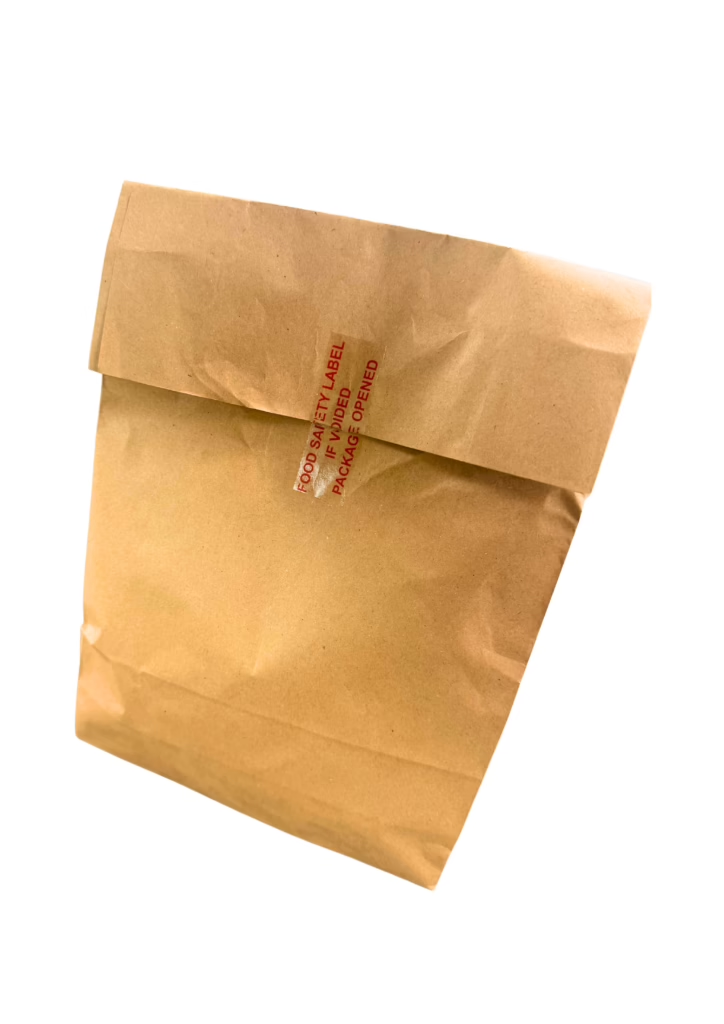
- kraft and paper takeaway bags, sealed across the folded or glued top
- larger multi-order delivery bags
- burger cartons, pizza boxes and outer delivery cartons
- PP tubs, lids and drinks cups, hot or chilled
- sleeves, cutlery packs and click-and-collect handovers
The adhesive is specified for the real surface, whether that is dusty recycled kraft, coated board or plastic, and for the temperature at sealing. That means one supplier and one seal design can secure the bag, the box and the cup.
Your brand, plus useful data
The seal is the last thing the customer touches before they eat, so it should look like your brand rather than an add-on. TamperTech labels are UV flexo printed in your specified Pantone or spot colours, signed off from a physical sample. See custom tamper evident labels.
A label can also carry what a board case usually does not:
- A bespoke security message in place of a generic VOID, such as “Sealed for your safety” in your own wording
- Sequential numbering to link a seal to an order
- A barcode or QR code for tracking, feedback, reorders or promotions
- Order details printed at dispatch on a direct thermal construction
Less space, less freight, lower cost per order
A roll of labels sits in one hand and one dispenser. The same number of board cases fills boxes on a shelf or under the counter, in kitchens where space is already tight.
- Smaller and lighter to ship, so fewer deliveries, lower carriage cost per order sealed
- Simpler stock control: one roll format across bags, cartons and cups, instead of different board blanks for different bag sizes
- Less material bought per order, which usually means a lower unit cost; TamperTech quotes against your actual size, print and volume
- From trial to everyday supply: start with a trial, then move to recurring programme supply for single sites, groups and franchises. We ship worldwide every day.
Paper that stays with the paper bag
TamperTech’s food delivery seals are paper-based constructions, so the seal can stay in the paper waste stream with the bag it closes. Customers do not need to pick off a plastic seal before recycling, and you avoid adding plastic to an otherwise paper pack. Read more about paper tamper evidence.
That matters more each year as the EU Packaging and Packaging Waste Regulation (PPWR) and similar rules raise the bar on recyclability and packaging minimisation. Whether a finished pack is recyclable always depends on the whole pack and the local collection route, so TamperTech publishes material and declaration detail for its tested constructions on its PPWR and packaging compliance page.
Side by side
| Feature | Printed paperboard case | TamperTech paper tamper evident label |
|---|---|---|
| Liner waste at the counter | One loose siliconised strip per order (where a peel strip is used) | One roll liner, supplied on rolls |
| Time to apply | Pick, fold, fit, peel, press | About one second by hand: lift, place, press |
| Machine application | Depends on the case design | Ask us about formats for automatic application |
| Evidence of opening | Damage only, often arguable; can be eased off and refitted | Clear VOID or branded message; dry peel |
| Harder to copy | Plain print on card | Specialist material, bespoke message, Pantone colour, numbering |
| Traceability | None | Sequential numbers, barcode or QR |
| Sizes and pack types | One bag style per design | Made to the closure size you need; bags, cartons, cups, tubs |
| Storage and freight | Bulky boxes of blanks | Compact rolls |
| End of life | Board, plus any strip and liner | Paper-based, stays with the paper bag |
Frequently asked questions
What is a tamper evident food delivery label?
A tamper evident food delivery label is a seal applied across the closure of a takeaway bag, carton or container at dispatch. If anyone opens the pack before it reaches the customer, the label shows clear evidence, such as a VOID message, designed so that it stays visible on the pack.
How do tamper evident labels compare with cardboard bag seals or board cases?
They work differently. A paper tamper evident label is applied from a roll and shows a defined VOID or branded message when lifted. A printed board case is fitted over the bag top and shows damage if it is disturbed. Which suits you depends on your packs, volumes and the evidence you want; we can supply samples to test on your own packaging.
Can a tamper evident label be removed and stuck back on?
TamperTech labels are designed so that this shows. They are dry peel: once lifted, no tacky adhesive is left on the label or the pack to stick it back down, and the VOID message stays visible on the pack.
Are paper tamper evident delivery labels recyclable?
TamperTech’s food delivery seals are paper-based constructions designed to stay in the paper waste stream with the paper bag they close. Whether a finished pack is recyclable depends on the whole pack and the local collection route.
What sizes do tamper evident delivery labels come in?
Labels are made to the closure size you need and supplied on rolls.
Can delivery labels be printed with our logo, colours and order numbers?
Yes. Labels can be printed in your Pantone or spot colours with your own security message, sequential numbering, barcodes or QR codes, and order details can be printed at dispatch using direct thermal labels.
Can tamper evident labels be applied by machine?
Labels are designed for fast hand application with finger-lift tabs. Ask us about formats for automatic application.
Can we start with a trial order?
Yes. You can start with a trial from 1,000 labels, then move to recurring programme supply for single sites, groups and franchises.
Do you supply tamper evident delivery labels outside the UK?
Yes. TamperTech manufactures its own labels and ships worldwide every day, supplying single sites, restaurant groups, distributors and packaging converters.
Making the switch
Switching from board cases takes one sample run on your own packaging. Send TamperTech your bag, carton or cup and these details, and you will get samples and a firm quotation:
- Closure size, and whether the seal must bridge a fold, lid or curve
- Orders sealed per hour and approximate monthly volume
- Paper or filmic, depending on grease, moisture and temperature
- The evidence you want: VOID, your own message, or fibre tear
- Artwork, numbering, barcode or QR
- Hand application at the bench, or the applicator and line speed
Prefer to buy one item rather than a bag plus a seal? SealSafe™ tamper evident delivery bags build the evidence into the bag itself.