
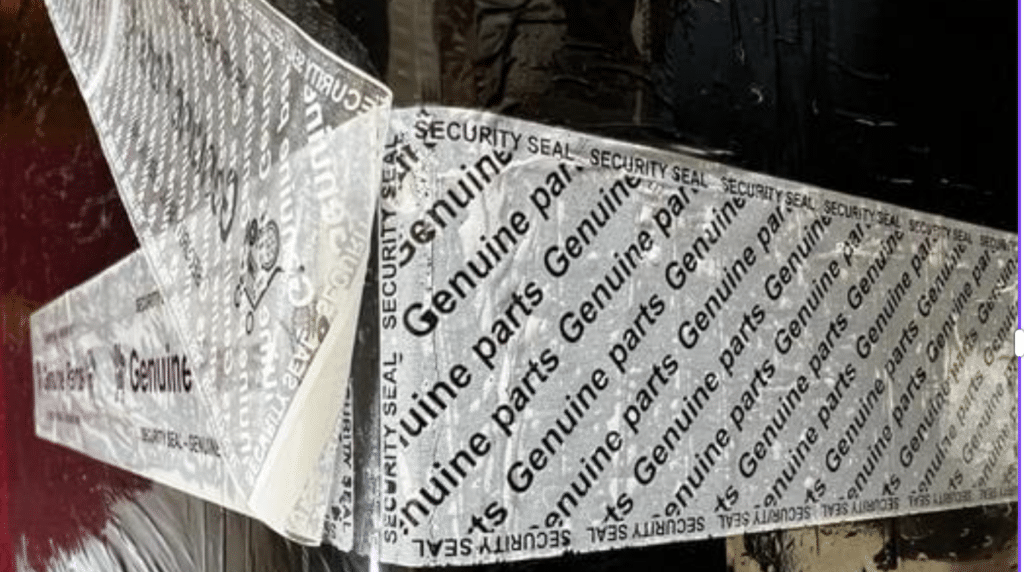
A tamper-evident tape can perform well on one carton and poorly on another, even when the two packs appear similar. The difference is often not the visible tape. It is the relationship between the adhesive, the surface, the application conditions and the evidence the user needs to see after an opening attempt.
That is why selection should begin with the actual pack and workflow — not with a request for “the strongest tape”.
Start with the evidence you need
Tamper evidence does not make a pack impossible to open. It is intended to provide a visible indication that an opening or removal attempt has taken place.
Before choosing a construction, decide what the receiving or inspection team must be able to identify. Depending on the application, that might be:
- a visible VOID or security message in the tape or on the surface;
- damage to the tape that makes an opening attempt apparent;
- a numbered or barcoded identifier that can be recorded through a process;
- a residue-free indication for a reusable container;
- a combination of visible evidence and controlled identification.
Identification and integrity are different functions. A printed number or barcode can identify the tape or pack. The tamper-evident construction provides visible evidence of an opening attempt. One does not automatically prove the other.
The surface is part of the specification
“Cardboard”, “plastic” or “metal” is rarely enough information on its own. Surface finish and condition can materially affect the bond.
Corrugated and coated cartons
Cartons may have uncoated fibres, varnish, print, recycled content or a smooth coated face. Dust from cutting and packing can also sit between the adhesive and the board. A construction that bonds well to a clean, consistent carton may behave differently on a dusty or highly coated surface. Where the pack and environment are already understood, a standard tamper evident tape may be appropriate.
Plastic totes and reusable containers
Reusable containers can carry mould-release agents, cleaning residues, scratches and surface wear. They may also need to return to service without a difficult residue-removal process. That can make a residue-free tamper-evident label or tape more appropriate than a permanent transfer construction — but only testing on the real tote can confirm the required behaviour.
Film, flexible packaging and curved packs
Flexible films move. Small containers and closures introduce curvature. Both can place continual stress on the edge of a label or tape. A test should therefore include the real pack shape and filled condition, not only a flat sample of the material.
Metal, glass and painted surfaces
These surfaces may appear clean but still carry oil, condensation, release agents or cleaning products. Painted and powder-coated finishes vary. The relevant question is not simply whether the adhesive sticks, but whether the complete construction gives clear, repeatable evidence without causing an unacceptable effect on the surface.
Check the application conditions
The temperature when tape is applied is not necessarily the same as the temperature during transport or storage.
A pack may be sealed in a warm packing area and then moved into cold storage. Another may be applied to a chilled surface carrying condensation. Those are different conditions and should not be treated as one temperature number.
Record:
- the temperature of the pack surface at application;
- the room or line temperature during application;
- the lowest and highest service temperatures;
- whether condensation, frost, dust or oil may be present;
- how quickly the pack moves after sealing;
- how long the tape has before it is inspected or challenged.
Allow for pressure, time and handling
Pressure-sensitive materials need consistent contact with the surface. Creases, trapped air, light application pressure and handling immediately after application can all change the result.
The trial should reflect the production process:
- prepare the pack as it would be prepared on the line;
- apply the tape using the intended manual or automatic method;
- use realistic pressure;
- allow the intended time before movement or testing;
- expose the pack to its real storage and transport conditions;
- inspect both the intact seal and the result after an opening attempt.
A quick hand application to a clean sample in an office is not a substitute for the real process.
Decide whether residue is acceptable
Permanent and residue-free constructions solve different problems.
A transfer construction may leave a visible message on the sealed surface as part of the evidence. A non-residue construction can provide evidence within the label or tape while leaving the reusable surface cleaner. The correct choice depends on the asset, the inspection process and whether the container must be reused.
The carrier material does not define the tamper mechanism. Paper and film constructions can both be designed around a dry-peel VOID or security-message reveal. Fibre tear is an optional behaviour in some paper constructions; it is not the definition of permanent tamper evidence.
Test what “failure” looks like
A useful trial does not ask only, “Did it stick?” It asks:
- Was the seal intact after normal handling?
- Was the opening evidence clear and repeatable?
- Could an inspector understand the result without specialist interpretation?
- Did the evidence remain visible under the expected lighting and working conditions?
- Was the remaining residue or surface effect acceptable?
- Did printing, numbering or barcoding remain readable?
- Could the application be performed consistently at operational speed?
The result should be judged against the process requirement, not against an abstract idea of maximum adhesion.
Stock tape, custom tape or an application-led construction?
A standard stock tape may be appropriate where the pack, environment and evidence requirement are already understood. Larger volumes or distributor requirements should follow the trade and volume route.
Custom print, colour, dimensions, security message or construction need a technical specification. The same applies when the surface is uncertain, the temperature range is difficult, the pack is reusable or the result has to fit a defined inspection workflow.
Manufactured in Ashbourne, Derbyshire, where converting, printing and quality control take place. Custom colours use UV flexographic Pantone/spot colour where appropriate to the specification.
Send us the pack
The most useful test starts with the item you actually need to secure.
Send us the pack, tell us where and how it is sealed, and explain what your team needs to see when it is inspected. Include the application method, surface condition, temperature range, reuse requirement and any numbering or print requirement.
SEND US THE PACK · Buy standard stock tape · Talk to us about volume
We will use the real application to help specify the construction rather than asking you to choose from an unsupported sample alone.