
Tamper evident labels

Tamper Evident Thermal Transfer Labels

Thermal transfer tamper evident labels are supplied blank and print ready, so you can add variable data in house while keeping full tamper evidence built into the label.

Available in filmic or paper, permanent or no transfer constructions, delivered on 76mm or 25mm internal diameter cores and made ready for wax or wax resin ribbons.

Thermal transfer tamper evident label showing the stages of the void message appearing

Tamper behaviour

What happens when the label is interfered with

The tamper evidence is engineered into the label construction, not into the print. Whichever ribbon and data you use, any attempt to remove or alter the label reveals a clear tamper message. Choose a no transfer construction to leave the surface clean, or a permanent construction to leave a transferred message behind.

01

Print on demand

You overprint barcodes, batch data, serial numbers or branding on your own thermal transfer printer.

02

Interference

Lifting, peeling or altering the applied label separates the construction.

03

Visible evidence

An irreversible void message appears, so the seal cannot be reused or reapplied unnoticed.

Tamper evident thermal transfer labels▶Video

Tamper evident thermal transfer labels

Shows a printed paper tamper evident label and the message revealed when the label is lifted from the pack.

Watch on YouTube ↗

Why print ready

Why choose thermal transfer tamper evident labels

Data in house, immediately

Print variable data as you need it instead of waiting for a printed production run.

Both tamper constructions

Specify no transfer for clean removal or permanent for total transfer evidence.

Durable print

Sharp, smudge resistant images that withstand heat, moisture, abrasion and chemical exposure.

Long roll formats

Roll lengths tailored to your workflow, up to 5,000 or 10,000+ labels per roll for fewer change overs.

Ribbon ready

Receptive to wax and wax resin ribbons with no special printer required.

Simple integration

Works with existing printers and packaging systems, by hand or on line.

How the print works

Thermal transfer printing explained

Thermal transfer printing uses a heated printhead to melt ink from a ribbon onto the label material, producing sharp, long lasting images and text.

01

Ink ribbon

The printer runs a ribbon coated with wax or resin based ink.

02

Heat transfer

The printhead heats the ribbon selectively according to the image or text being printed.

03

Durable result

Melted ink bonds to the label face, giving crisp, smudge and fade resistant print.

Compared with direct thermal, thermal transfer print resists fading, abrasion and harsh environments, which suits labels that must stay legible through the whole supply chain.

Two decisions, not one

Print method, tamper construction and format

If you need to print variable data yourself, work through it in this order: choose the print method, then the tamper construction, then confirm the roll and printer format. They are independent decisions and each one has its own page.

Decision 1

Thermal transfer or direct thermal

Thermal transfer prints through an ink ribbon onto compatible label stock. Direct thermal has no ribbon: the image is created in a heat-sensitive coating. The distinction matters when the seal has to stay legible for a long time or through heat, light and friction, because a ribbon-printed image is not dependent on that coating. If your labels are read and discarded quickly, direct thermal may be the simpler route.

Decision 2

Then the tamper construction, separately

Thermal transfer is a printing method. It does not decide what the label leaves behind, or whether the face is paper or film. Permanent, partial and non-residue constructions, and paper or filmic faces, are chosen against the pack and the evidence you need — then supplied print ready.

Decision 3

What we confirm before supply

Most print-on-demand problems are format problems, not label problems. These are specification details to confirm with us against your own printer rather than assumed from a datasheet:

  • Printer make and model
  • Label width and length
  • Roll direction and wind
  • Core and roll format
  • Ribbon compatibility against the face material you have chosen

Decision 4

Variable data you print yourself

Yes — the stock is supplied blank and print ready so serial numbers, barcodes, QR codes and batch or reference data are printed on your own thermal transfer printer, as you need them. That is separate from data applied by us at manufacture, which is the right route when the number or code must not depend on your line.

Not sure which construction the pack needs, or whether your printer and ribbon will hold the print? Send us the pack → and we will specify it with you before you commit a batch.

Construction and specification

Specification, formats and customisation

Materials and construction
Face materialsFilmic or paper, specified to the surface, environment and printer.
Tamper constructionsNo transfer for residue free removal, or permanent for total transfer evidence.
Print methodThermal transfer, receptive to wax or wax resin ribbons.
Cores76mm or 25mm internal diameter, supplied print ready.
SurfacesPlastic, glass, metal and cardboard. Heavily textured or uneven surfaces are tested first.
Customisable options
  • Colours
  • Base material
  • Label size and roll length
  • UV ready inks
  • Custom void message
  • Security cuts
  • Sequential numbering
  • Barcodes and QR codes
  • Logos and brand print

Labels are largely supplied blank and ready for your own print, in rolls from 5,000 labels.

Environment and durability
Standard supply chainAmbient warehousing, transport and retail conditions.
Cold chainFreezer grade paper label and tape constructions are available for cold chain applications.
Print durabilityResistant to heat, moisture, abrasion and chemical contact once printed.

Specification routes

Print-ready specification routes

Thermal transfer stock is only half of a specification. These are the routes that decide what is already on the label before it reaches your printer, and what your ribbon has to add. Each one is a separate decision, so each has its own specification page.

Red permanent label with a white overprint panel — 70mm x 30mm

Red permanent  /  70mm x 30mm  /  full transfer  /  white panel for overprinting

View specification →

Purple permanent label with a white overprint panel — 70mm x 30mm

Purple permanent  /  70mm x 30mm  /  full transfer  /  white panel for overprinting

View specification →

Custom VOID message wording

Set at manufacture  /  wording you specify  /  revealed on removal

View specification →

Factory-applied sequential numbering

Pre-printed number ranges  /  removes the need to print the number yourself

View specification →

Pre-printed surface barcodes and QR codes

Applied at manufacture  /  scan-verified  /  use when the code must not depend on your line

View specification →

Dual number tab for two-part records

Matching number on label and peel-off tab  /  one number stays with the paperwork

View specification →

UV inks for covert verification

Invisible under normal light  /  needs a UV lamp at the check point

View specification →

If your artwork, print method or ribbon combination is not covered by one of these, send us the pack and the label you are printing today and we will specify it.

Applications

Where thermal transfer labels are used

Returns and reverse logistics

Return inside labels sent out with the order, applied by the customer on return, so opened or switched items are visible and friendly fraud claims can be challenged.

Secure documents and envelopes

Legal paperwork, financial records and confidential correspondence, where a numbered, barcoded seal supports chain of custody.

Document boxes and archive cartons

Sealed storage and transit boxes carrying sensitive information, with a clear void message on any attempted access.

Food delivery packs

Bags, pizza boxes and plastic containers, giving the driver and the customer clear evidence that the pack has not been opened.

Shipping pouches and diplomatic pouches

Permanent constructions bonded to pouches and mailers where the seal must not be reusable.

Pharmaceuticals and regulated packs

Batch and expiry data printed on demand, with tamper evidence for compliance sensitive packaging.

Item collection and click and collect

Sealed collection bags and parcels handed over at store or locker, with numbered seals for reconciliation.
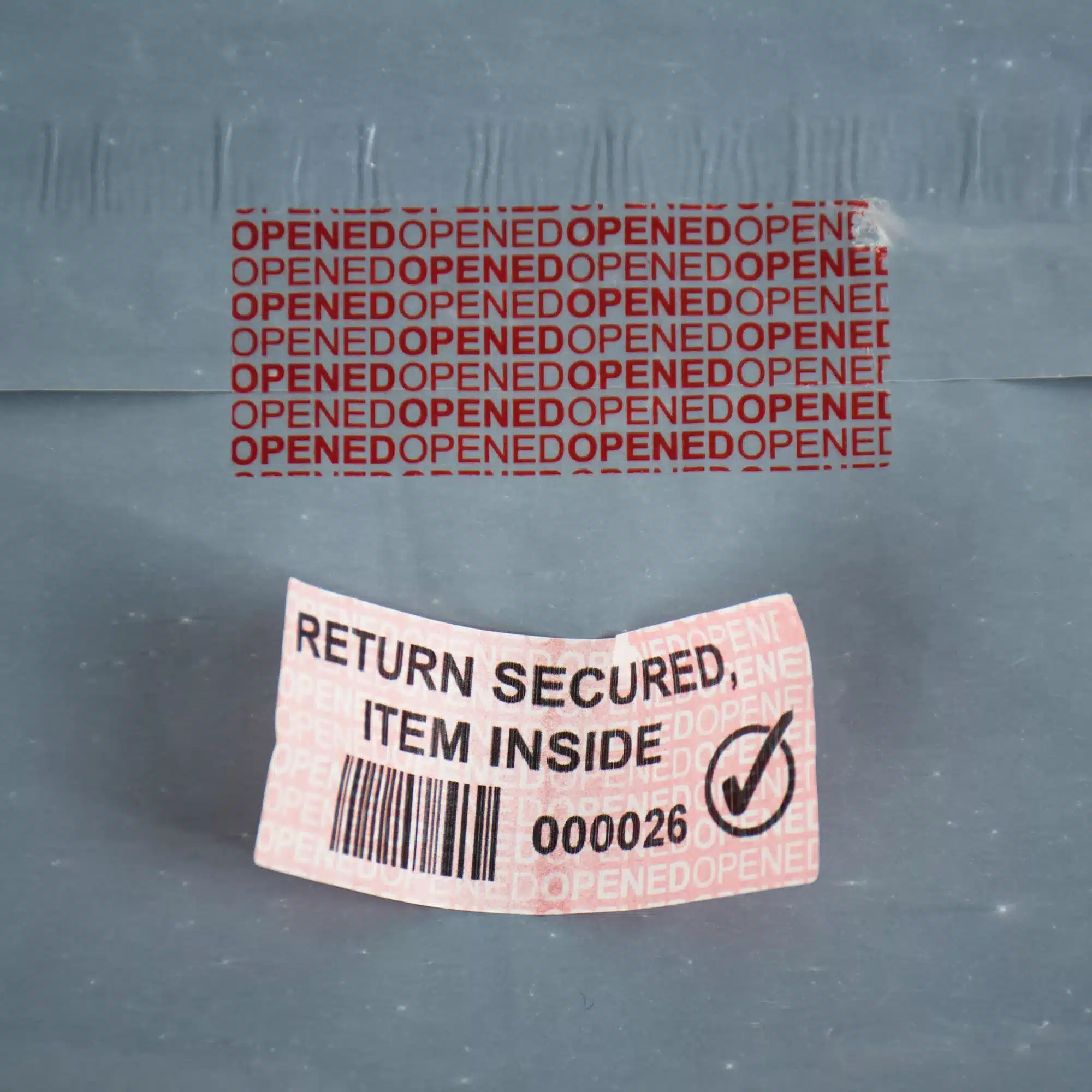
Returns tamper evident label showing the void message after opening
Returns seal, void message
Document box security label part voided after an access attempt
Document box seal, part voided
Tamper evident security label applied to a shipping pouch
Shipping pouch seal

Application and integration

Printing and applying on your line

Printer compatibility

Standard thermal transfer printers, no specialist equipment required. Ribbon formulation is matched to the label face material, surface coating, printer and durability requirement, and confirmed by test on the actual construction.

Roll and core

We match label size, labels per roll and core diameter to your printer and applicator.

Hand or automatic

Apply by hand at pack and dispatch, or feed reels into semi and fully automatic applicators.

Send us your printer model, roll requirement and the surface, and we will confirm the construction and format.

Getting the print right

Ribbon, heat and print methods that are not thermal transfer

The tamper evidence is in the construction, so ribbon choice does not change how the label voids. It changes whether your text and barcodes are still legible after handling, and no single ribbon formulation is correct for every paper or every filmic construction.

Matching principleRibbon formulation must be matched to the label face material, surface coating, printer and durability requirement. Carrier material alone does not decide it.
WaxCommonly suited to coated and uncoated papers where modest durability is sufficient.
Wax resinCan suit coated papers and some synthetic and filmic materials, depending on the surface coating and the handling the label sees.
ResinTypically chosen for synthetics where higher abrasion, chemical, heat or environmental resistance is required.
Confirm by testSuitability should be tested on the actual TamperTech construction with your own printer and ribbon, rather than selected by carrier material alone. We will run that check with you before you commit a batch.
Heat and speedFilmic and synthetic stocks often need a different speed and heat balance from papers. Set it once against the actual roll and printer, then lock the profile in the printer preset so operators are not re-tuning per shift.
Barcode verificationVerify the barcode grade on the finished label after it has been applied and flexed, not on a flat sample straight out of the printer.

Print methods to rule out first

01

Direct thermal

No ribbon, so the image comes from a heat-sensitive coating and fades with heat, light and friction. Reasonable for short-life despatch labels, not for a seal that has to stay readable for months. See direct thermal tamper evident labels for where it does fit.

02

Laser and inkjet

These stocks are specified for thermal transfer. Toner fuser heat and inkjet ink on a filmic face are outside that specification, so ask before running them through an office printer rather than finding out on a live batch.

03

Pre-printed instead

If the only variable element is a batch code, pre-printed brand and warning wording with a small variable panel is usually cheaper and more consistent than printing the whole label in house. Compare in the label range.

Durability, described honestly

With a correctly matched and tested ribbon the print resists smudging, moisture and incidental oil contact in normal handling. Chemical, solvent, abrasion and outdoor exposure are specification questions with real limits, and the answer depends on the face material, not the ribbon alone. Send us the pack and the exposure it actually sees and we will tell you what holds up.

Specifying print-your-own stock

Specifying tamper evident label stock you print yourself

Searches that land here are usually asking one of two things: can I print variable data onto tamper-evident label stock on my own printer, and will that print survive? Both come down to specification detail rather than product choice.

What the stock actually is

  • Tamper evident label material supplied as printable roll stock, available in both tamper constructions — permanent, where the security message transfers to the surface, and non-residue, where the label lifts cleanly and the message stays on the label.
  • The tamper behaviour is built into the construction. Printing adds your data; it does not create or change the tamper mechanism.
  • Any fixed security message, brand or colour is pre-printed as UV flexographic spot colour to a Pantone reference — that is a production step, not something your printer does.

Printer and ribbon compatibility

  • Thermal transfer, not direct thermal: an ink ribbon is fused to the label by heat, which is what makes the print durable rather than heat-sensitive.
  • Confirm printhead width, roll diameter, core size and wind direction against your printer before ordering — these, not the label itself, cause most print-on-demand problems.
  • Ribbon grade matters. Match ribbon to the label face and to the abrasion, moisture or chemical exposure the label will meet.
  • Run a real print job on your own printer at production speed before a specification is fixed.

Variable data and barcodes

  • Sequential numbers, barcodes, batch and date data, asset references and destination detail can all be produced in house on demand, which is the point of printing yourself.
  • Check that barcodes still scan after the label has been applied, handled and — where relevant — partly disturbed, not just straight off the printer.
  • On a permanent construction, plan where the data sits relative to the area that voids, so the record is not destroyed by the evidence.
  • Where the seal must be logged, decide at specification time who records the number and who checks it.

Where it fits, and where it does not

  • Good fit: returns and reverse logistics, secure documents and envelopes, archive and document boxes, asset and equipment labelling, and any workflow where each label carries different data.
  • Less suitable: high volumes of identical labels with heavy security print — pre-printed custom labels are more economical and give better print quality.
  • Not a substitute for construction choice. Decide permanent versus non-residue first, then decide how you print it.
  • Print quality and tamper performance are separate tests. Both need running on your real pack.

A voided or disturbed label evidences interference with the seal. It does not confirm the contents of the pack, and printed data is only an audit trail where it is recorded at seal and checked on receipt.

Questions

Thermal transfer tamper evident label FAQs

What are thermal transfer tamper evident labels?

Labels that use thermal transfer printing for durable, high quality images and text, with tamper evidence built into the construction so a visible mark is left if someone tries to remove or alter them.

How do they work?

The adhesive and material combination means the applied label cannot be removed without leaving a visible trace, such as a void message or a permanent residue on the surface.

Which industries use them most?

Pharmaceuticals, logistics, retail, electronics and automotive, where product integrity, consumer safety and brand protection are priorities.

What are the benefits of thermal transfer printing?

You can print data in house immediately rather than waiting for a manufacturer, and the print is sharp and smudge resistant under heat, moisture and chemical exposure, so critical information stays legible.

Are these labels customisable?

Yes. Branding, logos, colours and messaging can all be specified. They are largely supplied blank and print ready in rolls of at least 5,000 labels.

Can they be used on any surface?

They adhere to plastic, glass, metal and cardboard. Very textured or uneven surfaces should be tested first.

Are they eco friendly?

Many are made from paper and eco conscious materials, a sustainable alternative to plastic based security labels. Paper label and tape options exist for cold chain and freezer use too.

How do I know this is the right choice?

If your product needs protection from unauthorised access, counterfeiting or tampering, a tamper evident label gives you security, traceability and reassurance. If you are unsure, send us the pack through the Security Lab.

Are there regulations around tamper evident labels?

Some industries, such as pharmaceuticals and food packaging, have requirements for tamper evident features. Check the guidelines that apply to your sector.

Next step

Specify your print ready label

Need samples or a quotation?

Tell us the printer, the roll requirement and the surface and we will send samples and a quotation.

Not sure this will work on your pack?

Put it through the Security Lab. Send us the pack and the problem and our technical team will specify the solution with you.