
Application · Logistics

Tamper Evident Labels for Shipping Containers

Between origin and delivery, a container is checked by people who were not there when it was sealed.

Container, trailer, drum and hatch seals need to survive weather and handling, and to leave unmistakable evidence if they are lifted, slit or scraped. Dual number tabs let the same seal be recorded on the shipment and on the paperwork.

Know what you need? Talk to our team. Not sure what will work? Send us the pack.
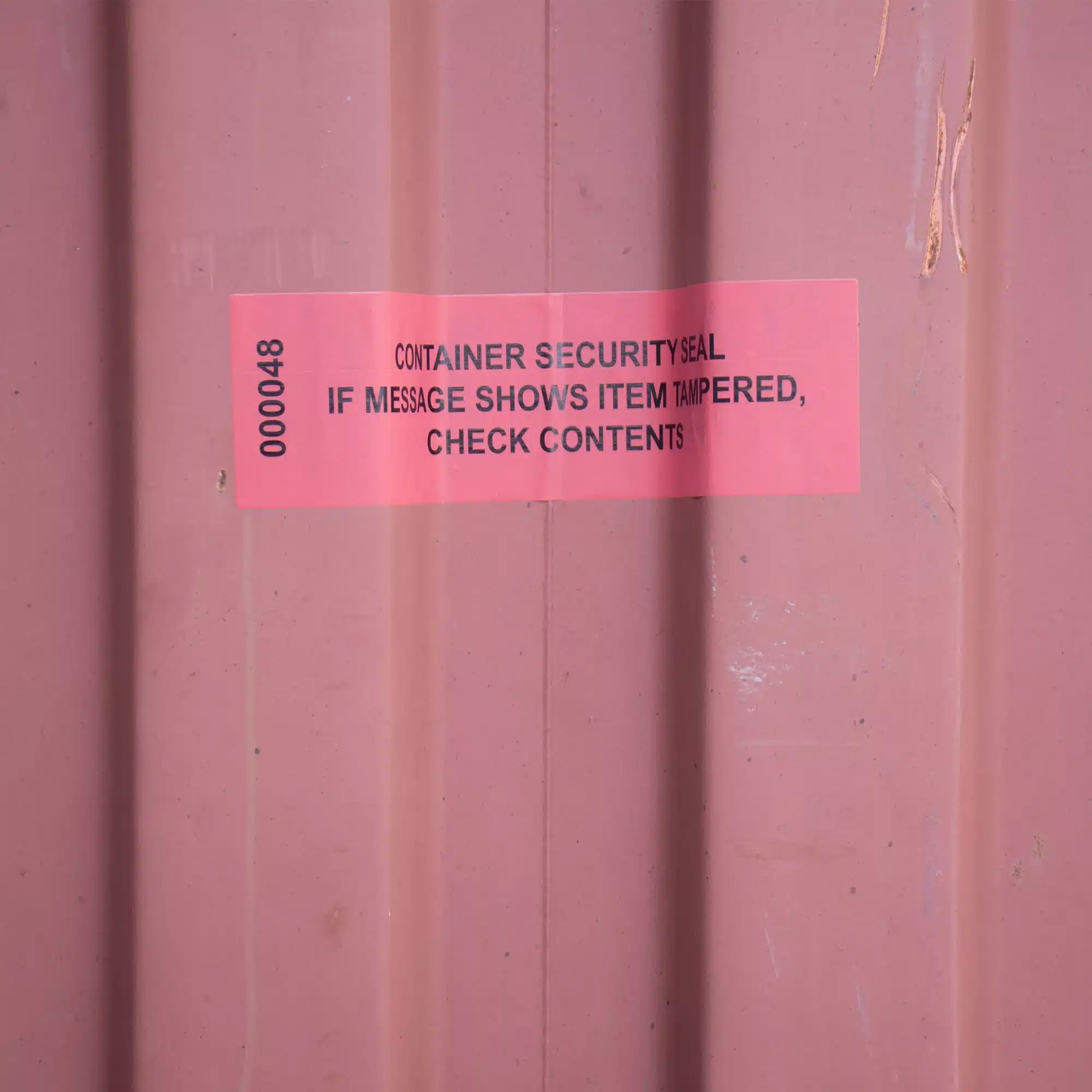
Container security label applied to a shipping container door

The problem

Where container security breaks down

01

Multiple custody handovers

Ports, borders, customs inspection and yard moves all involve different people. Evidence has to be readable by someone with no knowledge of how the container was sealed.

02

Harsh conditions

Salt air, condensation, heat and rain defeat ordinary labels. A seal that lifts on its own is worse than no seal, because it destroys confidence in the evidence.

03

Paperwork and pack recorded separately

If the seal number is not tied to the manifest or bill of lading, a substituted seal is hard to detect at the destination.

What interference reveals

Applied, disturbed, evidence

The label bonds to the door, latch or drum lid. Removing, slitting or scraping it leaves a void or opened message that cannot be hidden.

Container secure labels on a roll
Supplied on the roll with number tabs.
Container security label applied to a container door
Applied across the door seal or latch.
Container secure label film showing tamper evidence
Disturbed: the void message is released in the label film.

Product routes

Constructions and options

Permanent, high-tack labels

Bonds to steel, painted and powder-coated surfaces and plastic drums, and stays bonded through transit.

Non-residue labels

Where the asset is reusable and the surface must be left clean.

Dual number tabs

Two matching serial tabs: one stays with the shipment, one goes on the bill of lading, manifest or customs document for cross-checking.

Specification

Specification

Label size320mm x 90mm plus 2 x 25mm x 90mm number tabs
AdhesiveHigh-tack permanent, or non-residue for reusable surfaces
SurfacesSteel containers, plastic drums, painted and powder-coated panels
Print optionsCustom colours, warning messages, logos, barcodes, QR codes
Writable surfaceYes — for manual sign-off
ConditionsSpecified for outdoor transit including heat, cold, salt air and condensation

Sizes and adhesive are confirmed against your container type and route before order.

Application and integration

Application and integration

Surface preparation
Apply to a clean, dry surface. Grease, frost and heavy dust reduce the bond and can produce false evidence later.
Seal position
Across the door seal, latch, hatch or drum lid so that any opening breaks the label. Position is agreed with your operations team for each asset type.
Recording
Record both tab numbers at the point of sealing: one with the shipment, one on the transport document. Checks at destination compare the number and the label condition.
Inspection routine
Give receiving teams a simple checklist: number matches, label intact, no void or opened message, no lifted edges.

Useful guidance

Useful guidance

Non-residue tamper evident labels

Clean removal from reusable assets and painted surfaces, with the void pattern still released on lifting.

Permanent tamper evident labels

High-tack construction for outdoor and single-trip seals where the label should stay put.

Next step

Specify the container seal

Route, surface and inspection process all shape the specification.

Known requirement

You know the asset, size and numbering you need. Talk to our team about print and volumes.

Not sure what will work

Tell us the route and the asset, or send us a panel sample. We will confirm the adhesive and label format that will survive it.