
Clinical waste
Tamper evident labels for clinical waste bags
A sealed clinical waste bag should be able to show, on arrival, that nobody has been into it since it left the ward. These labels close the bag, carry the traceability information, and void if the seal is broken.
Written on at the point of use, checked at collection. If you need the label to survive a specific bag film, temperature or storage condition, send us the bag and we will specify it.

What happens when it is disturbed
Sealed, handled, evidenced
The point is not to make a bag impossible to open. It is to make an opened bag obvious to the next person in the chain, so a break in custody is discovered rather than assumed.

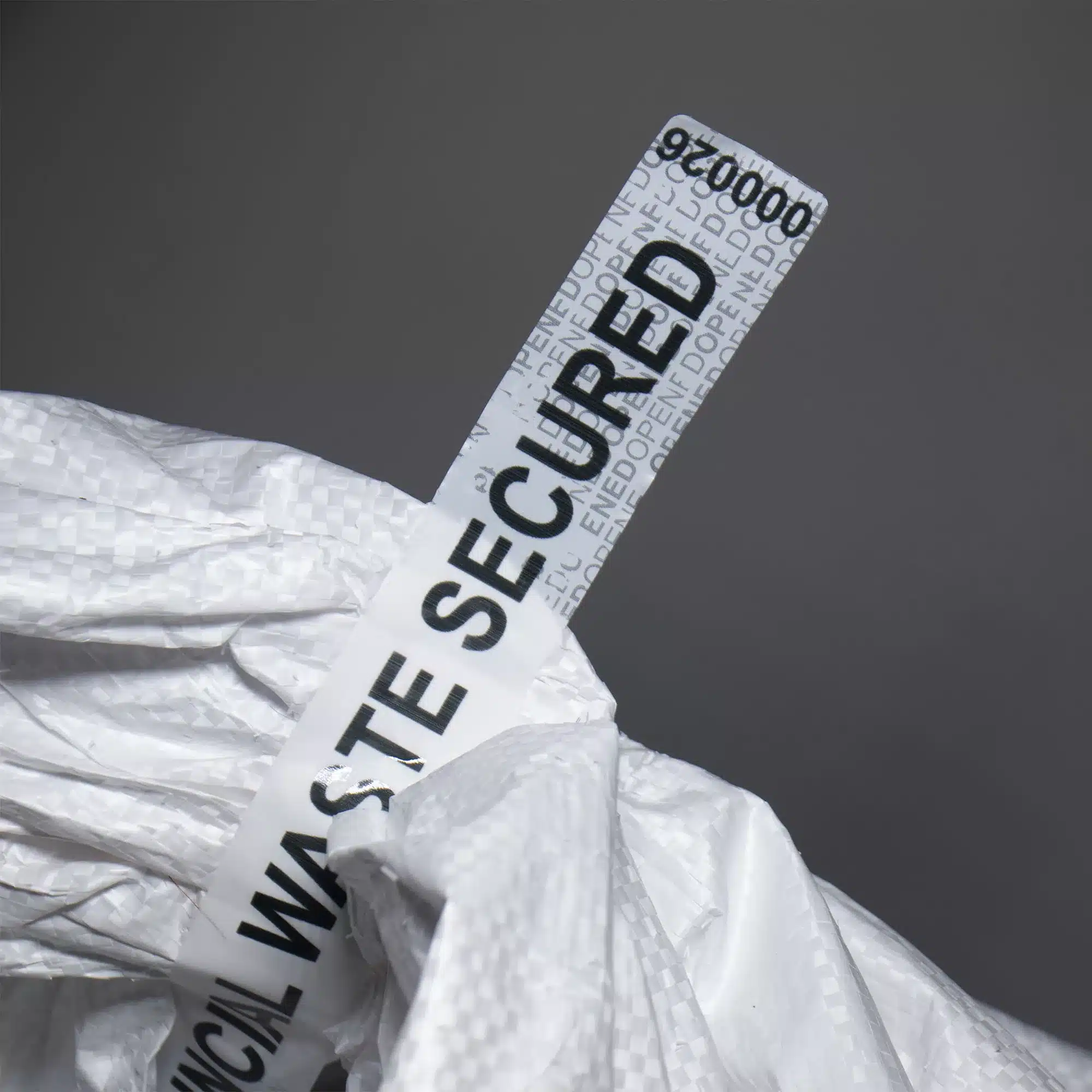

When to use it
- Clinical, offensive and pharmaceutical waste streams where custody has to be demonstrable, not just recorded.
- Sites with multiple internal handovers — ward, holding room, external compound, contractor vehicle.
- Where the ward, date, time and signature need to travel physically with the bag.
- Where a waste contractor or auditor may reasonably ask when a bag was last opened.
When not to use it
- As a substitute for your duty-of-care documentation. The label evidences the seal; it does not replace consignment paperwork or waste classification.
- On bags that are intentionally opened and topped up — seal at final closure only, or you will train people to ignore voids.
- Where the requirement is proving what is inside the bag. That is classification and documentation, not tamper evidence.
- On untested films. Some bag materials stretch or resist adhesion; confirm on your actual bag before rollout.
Specification
What to specify when you order
| Format | Wrap-around neck seal or flat label, on rolls or in pads for point-of-use application. |
|---|---|
| Write-on panel | Ward or department, date, time, operator signature. Specify pen type so the panel accepts it reliably. |
| Traceability | Optional sequential numbering, barcode or QR so the seal can be scanned at collection. |
| Void behaviour | Full or partial transfer. Partial transfer leaves evidence on the bag as well as the label. |
| Bag material | Tell us the film and gauge — adhesion and void performance depend on it. |
| Conditions | Application and storage temperature, humidity, and whether bags are held in chilled or outdoor compounds. |
| Colour and wording | Stream-specific colours and wording so the right seal is used on the right bag. |
What to test before you commit
01
Your bag film
Apply to the exact bag in use. Check adhesion on a stretched, part-filled neck as well as a flat sample.
02
Point-of-use practicality
Can it be applied with gloves on, one-handed, at a bin? If not, it will be skipped.
03
Legibility of the write-on panel
Test the pens actually available on the ward. Smudged information is no information.
04
Whole journey
Follow one bag from ward to contractor vehicle and confirm the seal is still readable and intact at each handover.
05
Recognition at collection
Show a voided seal to the people accepting the load. Agree what they do when they see one.
06
Escalation route
Decide in advance who is told, and what is recorded, when a bag arrives voided. Evidence without a process changes nothing.
Where this goes next
- Healthcare overviewWhere seal evidence fits across wards, pharmacy and waste.
- PharmaceuticalControlled and returned medicines, where custody matters most.
- Tamper evident label rangeConstructions, substrates and void behaviours.
- Our credentialsCertifications and standards, in one place.
Send us the problem
Let us specify it against your bag
Send a sample bag and tell us how it is handled between the ward and the contractor. We will tell you what will hold, and what will void usefully.
Talk it through
Discuss your requirement
Formats, numbering, stream colours, volumes and lead times. UK manufacture, UK technical support.