
OEM packaging
Warranty tamper evident labels
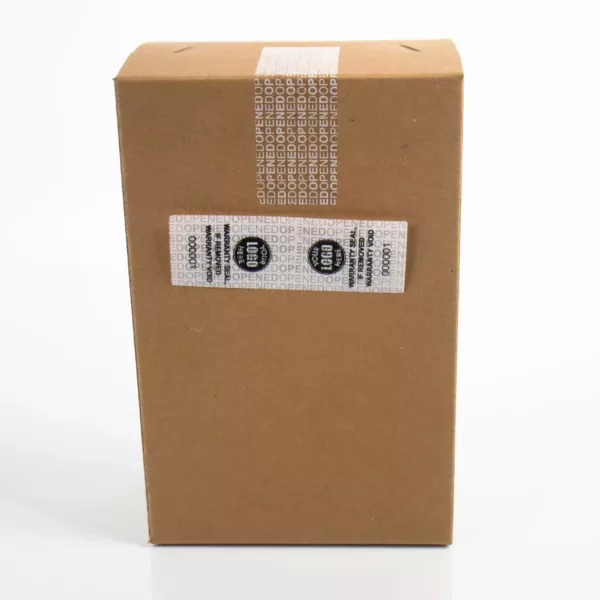
A numbered seal across the access point of a product or enclosure, so a warranty claim can be assessed on evidence rather than argument about whether the unit was opened.
Available in permanent and non-residue constructions, in paper and film, sized to the joint rather than the box.

What happens when it is disturbed
What the seal actually proves
A warranty seal evidences that the access point was opened. It does not prove who opened it, and it is not on its own proof that a product is genuine — that is authentication, and it needs a separate feature. Keep the two claims apart in your warranty terms and your service scripts.


When to use it
- Electronics, appliance and automotive enclosures where opening voids cover.
- Service and repair control — only an authorised centre breaks the seal, and re-seals with a logged number.
- Rental and loan equipment returned for inspection.
- Assemblies where an internal adjustment would create a safety or calibration risk.
- Claims processes that need a defensible, photographable record.
When not to use it
- As anti-counterfeit protection on its own. A copied product can carry a copied seal.
- As access control. It records interference; it does not prevent it.
- Across ventilation, moving parts or a joint that flexes in normal use.
- On textured, oily, low-energy or freshly moulded plastics without a substrate trial.
- Where the terms of your warranty do not actually reference the seal — fix the wording first.
Choosing
Which tamper behaviour suits the workflow?
| Permanent | Removal leaves the void message on the housing. Strongest for claims evidence; accept that the mark stays. |
|---|---|
| Non-residue | Removal leaves the surface clean; the control is the unique numbered seal and its record. Best for premium finishes and refurbishment. |
| Hybrid (rub-off) | Evidences opening but can be removed for re-use, so it suits internal checks more than external claims. |
| Paper or film | Paper suits paper-led packaging specs; film tolerates handling, moisture and curved housings better. |
What to specify when you order
| Construction | Permanent or non-residue tamper-evident label, paper or film. |
|---|---|
| Transfer behaviour | Permanent leaves the message on the housing; non-residue leaves it clean and relies on the seal number. |
| Numbering | Sequential numbers, barcodes or QR codes so a seal ties to a serial number and service record. |
| Surface | Exact housing material and finish — ABS, PC blend, powder-coated steel, anodised aluminium, laminate. |
| Geometry | Flat, curved or across a joint gap. Small seals for tight joints; tell us the radius. |
| Environment | Service temperature, humidity, UV exposure and expected life in the field. |
| Artwork | Void wording, logo, colour and any regional language requirement. |
What to test before you commit
01
Your housing
Test on production mouldings, including any release agent still present.
02
Ageing
Leave sealed units for the expected shelf and service life before attempting removal.
03
Determined removal
Warm, slow, careful peel. The evidence must survive an informed attempt.
04
Placement
Confirm the seal spans the only practical access route, not a decorative seam.
05
Service loop
Check authorised centres can re-seal and log a replacement number.
06
Claims process
Photograph a voided seal and confirm your claims team can read the evidence.
Where this goes next
- OEM packaging overviewSeals for assemblies, tools and equipment.
- Tool trolley labelsNon-residue seals for tooling and trolleys.
- Authentication and anti-counterfeitWhere a seal is not enough on its own.
- Tamper evident label rangePermanent, non-residue, paper and film.
Send us the pack
Send the housing or the joint
Send a housing, an off-cut or the enclosure itself, tell us where it opens and how long it must hold. We will specify the construction and show the evidence.
Talk it through
Discuss your requirement
Sizes, numbering, artwork, volumes and lead times. UK manufacture, UK technical support.