
Anti-Counterfeit Labels for Agricultural Products
Sealing and individualising agricultural packs so a refilled, substituted or re-labelled pack cannot pass as genuine.
Seed, fertiliser, crop protection and harvested produce move through long chains with many handling points. The commercial risk is not only opening a pack — it is emptying and refilling it, or moving a genuine label onto packaging that is not.
A tamper evident label that destroys itself on removal, combined with a unique number on every seal, means a pack has to arrive with its original seal and its recorded reference intact to be accepted as genuine.

What interference should reveal
Opened, refilled, or re-labelled — all visible
The label does not prevent someone reaching the contents. It is designed so that an interfered-with pack is hard to present as untouched.
01
Sealed and referenced
The label is applied across the closure and its consecutive number is recorded against the pack, batch or consignment.
02
Interference attempted
Lifting an edge breaks the label at its security cuts or begins to release the void layer, so the attempt starts to record itself.
03
Evidence remains
A permanent construction leaves a void message on the pack; a non-residue construction voids in the label itself. Either way the seal cannot be reinstated.
Real evidence
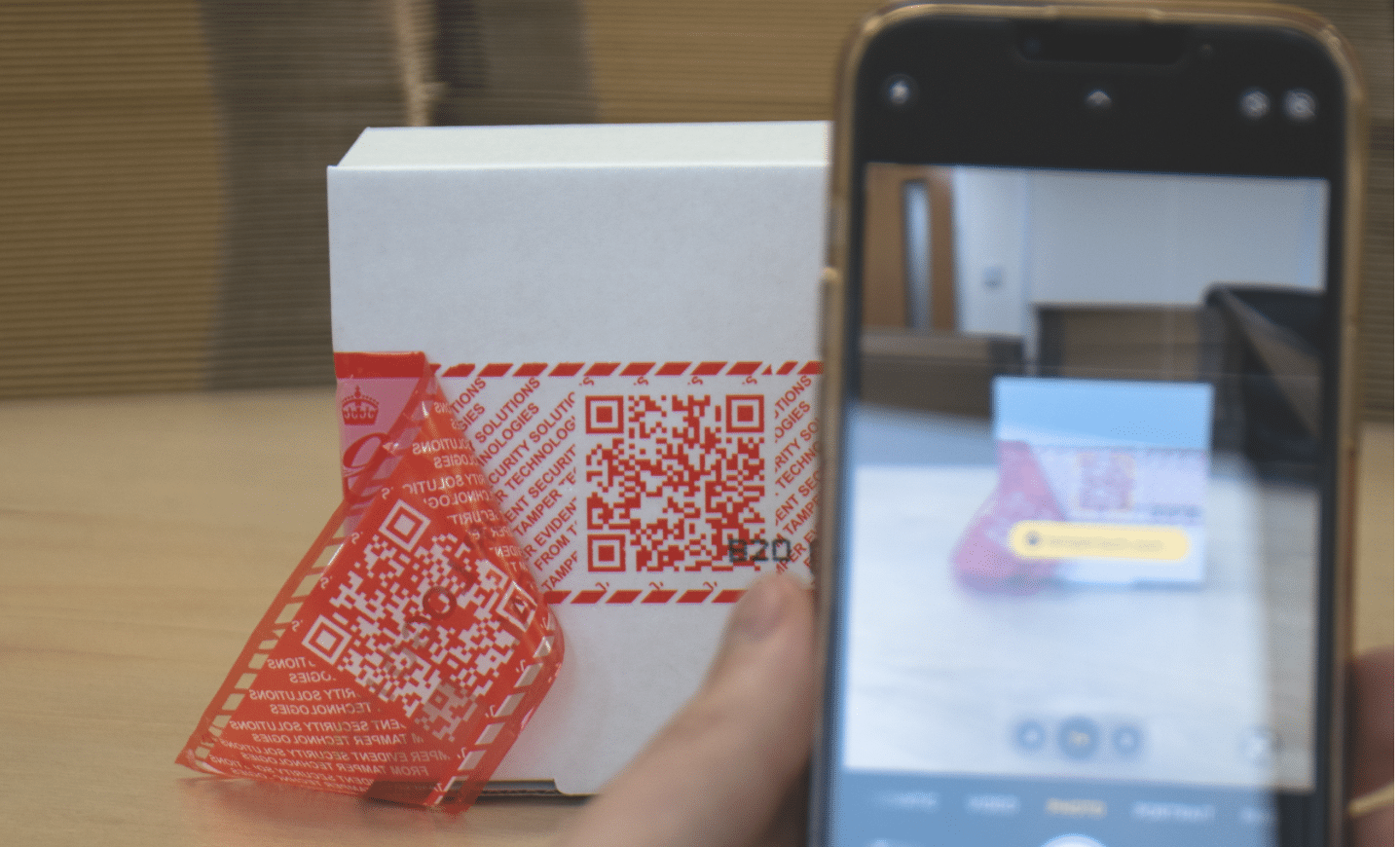
What it looks like on the pack
Images below are TamperTech product photography, not illustrations.


Product routes
Constructions used for this application
Permanent labels
Leave a void message on the packaging itself when removed. Used where evidence must stay with the pack — drums, cartons, rigid containers. Permanent labels.
Non-residue labels
Void within the label and leave the surface clean. Used on returnable or resold surfaces, and on packaging that must remain unmarked. Non-residue labels.
Paper constructions
Recyclable paper labels and tapes for packs that need to stay in a paper waste stream. Paper labels.
Individualisation
Consecutive numbers, barcodes, QR codes and bespoke void text, printed as part of the label. Custom labels.
Application and integration
Getting it onto the pack
Applying by hand
Labels are supplied on rolls for hand application. Surfaces should be dry, dust-free and above the minimum application temperature stated for the construction. Firm pressure across the whole label ensures the adhesive keys fully to the substrate.
Applying on a line
Formats can be supplied to suit semi-automatic and automatic label applicators, including core size, roll diameter, wind direction and gap. Tell us the applicator make, model and line speed and we will supply a format that runs on it.
Numbering and records
Consecutive numbering, barcodes and QR codes can be printed as part of the label so each seal has a unique reference that can be recorded against the pack, batch or consignment.
Checking on receipt
Give the receiving team a short check: is the seal present, is the number the one recorded, and is the label surface and its edges undisturbed? Anything else is treated as an exception.
Related
Where else this is used
Agriculture
The full agricultural application set, from field sampling to distribution.
Biosecurity labels
Sealing controlled areas, entry points and biosecure equipment.
Product sampling
Sealing grain and produce samples so the sample and its result stay matched.
Useful guidance
Before you specify
Label constructions explained
Non-residue, permanent and paper constructions, and what each one leaves behind.
Paper-based tamper evidence
Where a recyclable paper construction can replace a filmic one.
Custom tamper evident labels
Sizes, print, numbering and bespoke void messages.
Tell us what the pack is, how it closes and what has to be provable on arrival.
You know what you need
Formats, constructions, numbering and volumes — talk it through with the team and get samples or a quotation.
You are not sure yet
Send us the pack or the problem. The Security Lab looks at the application and helps specify the right level of security.